How to Smoke Prime Rib with a Herb Crusted Garlic Butter
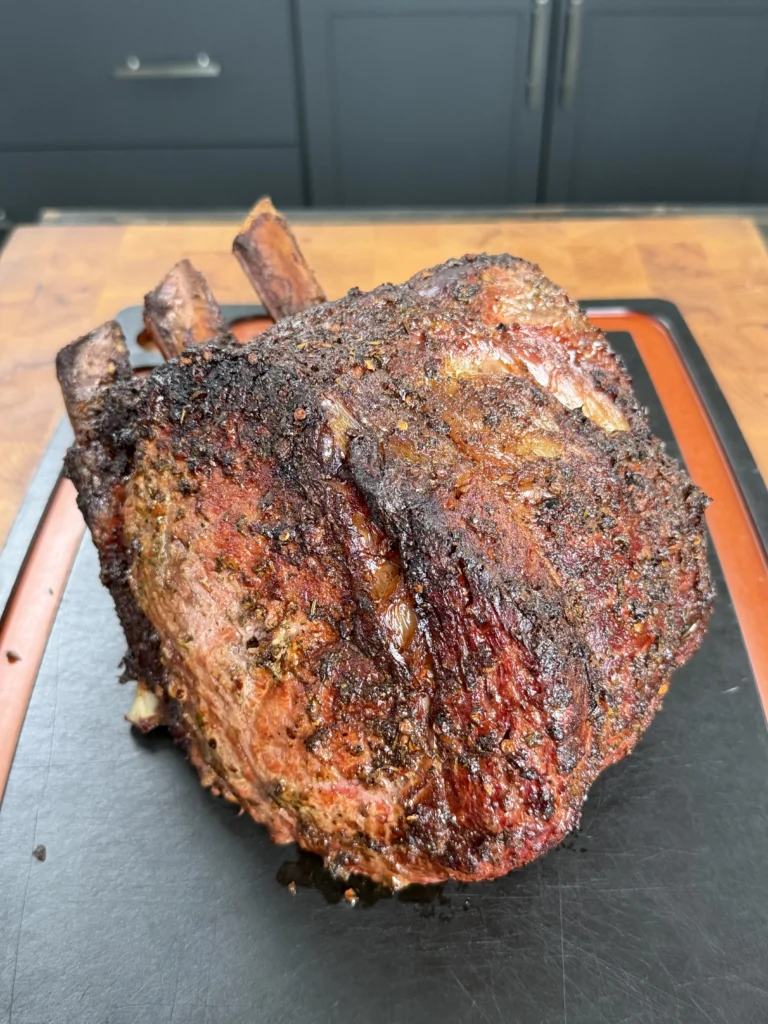
Smoked prime rib is a bone-in beef roast coated in garlic herb butter and slow-smoked at 225°F. You brush the roast with softened butter mixed with fresh rosemary, thyme, garlic, and Dijon mustard. Then smoke it over hickory or oak until it reaches 125°F internally for medium-rare. A drip pan underneath catches beef fat, butter, and aromatics like onions, carrots, and herbs. Those drippings become rich au jus. After smoking, you reverse sear the roast at 450-500°F to crisp the herb crust. The result is tender, juicy beef with a savory bark and restaurant-quality flavor.
The whole process takes about 5 hours including prep, smoking, searing, and resting. You smoke the roast low and slow so the fat renders and the meat stays moist. The garlic herb butter creates a crust that seals in juices while adding layers of flavor. The aromatics in the drip pan infuse the au jus with depth. This herb crusted prime rib serves 10 to 12 people and works perfectly for Christmas, holidays, or any special occasion where you want to impress.
Why Garlic Herb Butter Creates a Better Crust Than Dry Rub Alone
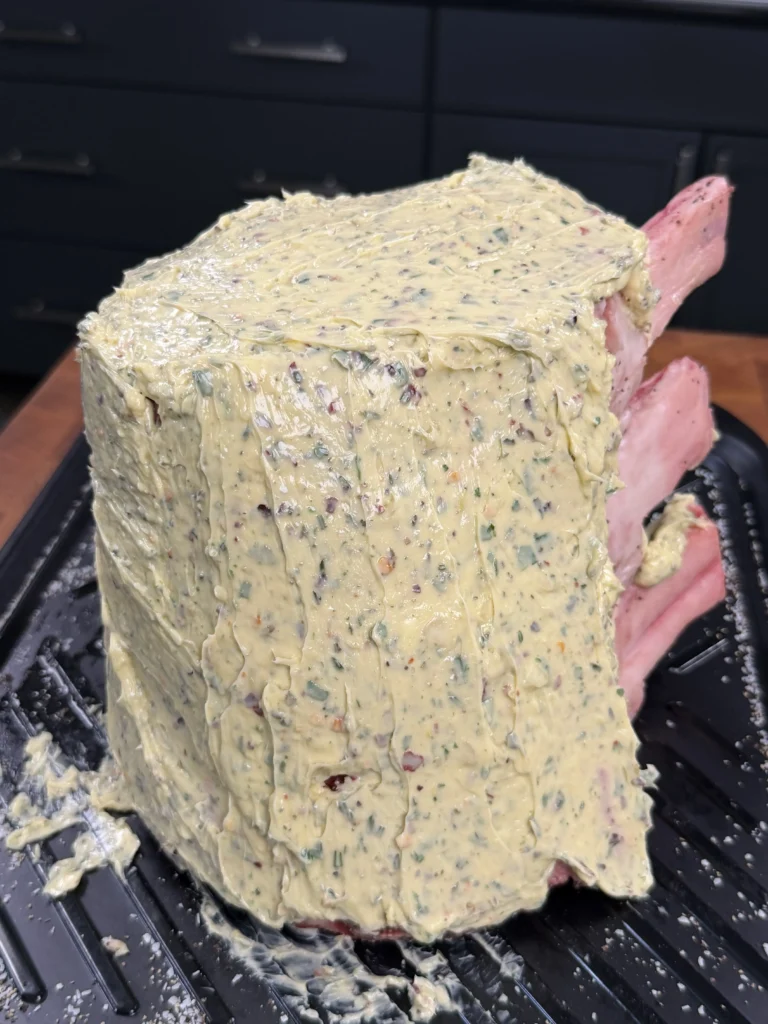
Garlic herb butter transforms smoked prime rib from good to exceptional. Fat carries flavor more effectively than water or air. When you coat the roast in softened butter mixed with fresh herbs and garlic, those aromatics bind to the fat molecules. As the prime rib smokes, the butter melts slowly and bastes the meat continuously. This creates deeper flavor penetration than dry rub alone.
The butter also improves crust formation. Prime rib has a thick fat cap that can stay pale and rubbery if you only use dry seasoning. The butter layer browns beautifully during smoking and especially during the reverse sear. It caramelizes along with the sugars in the Dijon mustard and creates a savory, crispy bark. The fresh herbs toast slightly, releasing oils that perfume the meat.
Dry rubs work fine for prime rib, but they sit on the surface. Butter penetrates as it melts. The fat seeps into the meat’s exterior layers while the solids create texture on top. You get both flavor depth and surface crunch. The herbs stay pressed against the meat instead of falling off like dried seasonings sometimes do.
Dijon mustard in the butter adds tang and helps the mixture adhere. The acid brightens the rich beef flavor. Lemon zest contributes citrus notes that cut through heaviness. These elements combine to create complexity that dry rub can’t match. You’re building layers rather than just seasoning the outside.
How the Drip Pan Creates Restaurant-Quality Au Jus
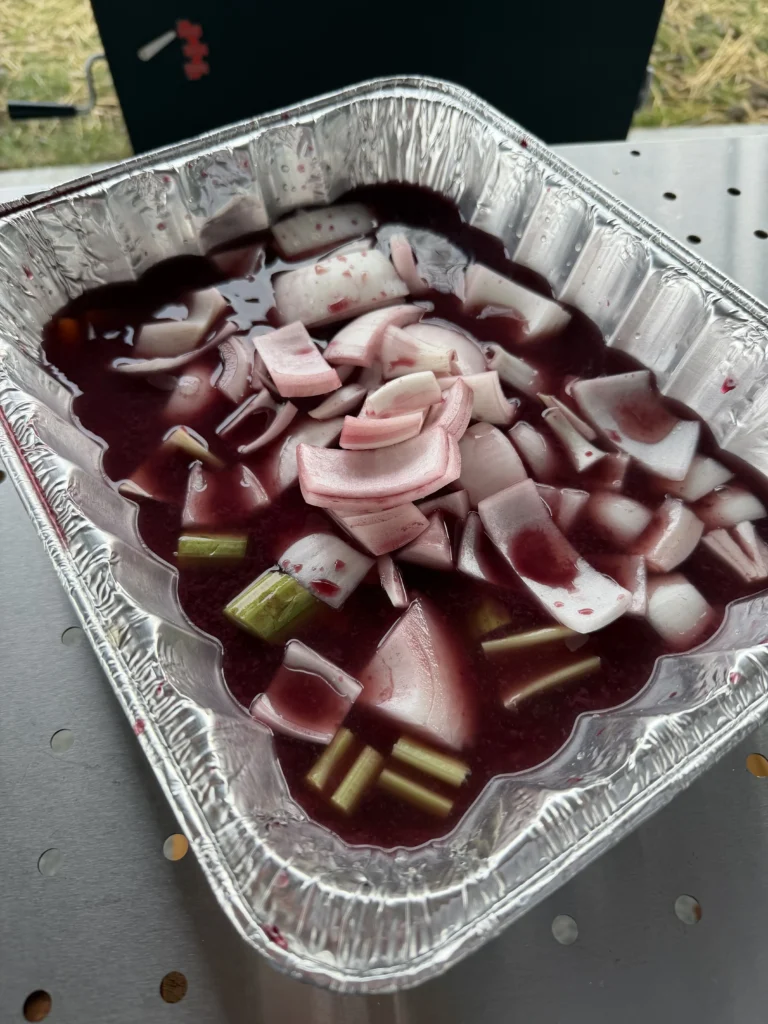
The drip pan under your smoked prime rib does double duty. It catches rendered fat so it doesn’t cause flare-ups in your smoker. More importantly, it collects every drop of beefy goodness that drips off the roast. You fill this pan with beef broth, aromatics, and herbs before smoking. As the prime rib cooks, fat and butter run down into the liquid below.
This creates natural au jus without extra work. The beef fat adds richness. The garlic herb butter contributes flavor. The smoke from your wood penetrates the liquid. The aromatics infuse their essence into the broth. Onions provide sweetness. Carrots add earthiness. Celery contributes vegetal notes. Fresh rosemary and thyme perfume everything.
You strain the drip pan contents after smoking and simmer them to concentrate the flavors. The result tastes like something from a steakhouse. It has body from the beef fat, depth from the aromatics, and smokiness from the wood. You can adjust the seasoning by adding salt, pepper, or a splash of red wine.
This method beats store-bought au jus or making it from scratch separately. You’re using the actual drippings from your specific roast. The flavors match perfectly because they came from the same piece of meat. Nothing gets wasted. Every element works together to create cohesive flavor.
The optional red wine and Worcestershire sauce deepen the color and add umami. Red wine contributes acidity and fruit notes. Worcestershire brings fermented complexity. Both are optional, but they elevate the au jus from good to exceptional.
Should You Score the Fat Cap Before Smoking Prime Rib?
Scoring the fat cap on prime rib helps the garlic herb butter penetrate and improves rendering. Prime rib roasts have a thick layer of fat on one side. This fat protects the meat during cooking and adds flavor. If you leave it completely intact, the butter sits on top without much adhesion. The fat also stays thick and chewy instead of rendering down.
Use a sharp knife to cut diagonal lines across the fat cap. Space them about an inch apart. Cut through the fat but stop before you reach the meat. Then cut perpendicular lines to create a crosshatch pattern. This creates more surface area for the butter to grip. The cuts also allow fat to render out more efficiently during smoking.
Don’t score too deeply. You want to cut through the fat layer but not into the actual beef. If you cut into the meat, juices will escape during cooking and the roast will dry out. The goal is just to create channels in the fat.
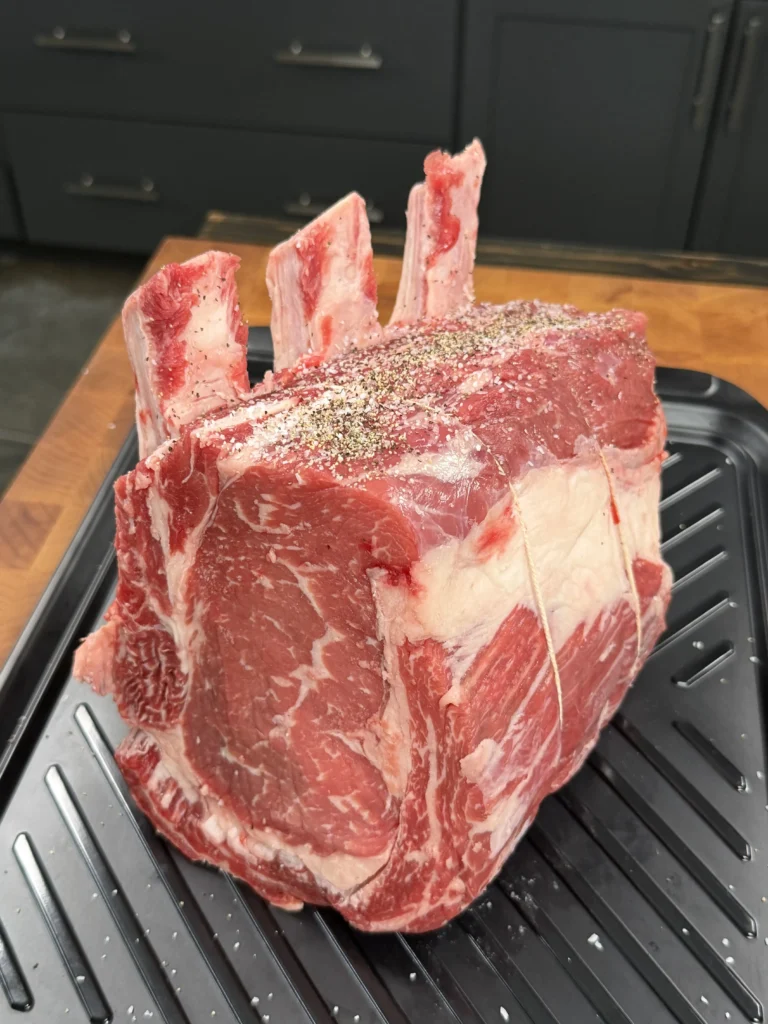
Scoring also helps with crust formation. The crosshatched fat creates peaks and valleys that brown differently during the reverse sear. You get varied texture across the surface instead of one uniform layer. The exposed meat in the score marks caramelizes while the fat renders.
If your prime rib has a very thin fat cap, you can skip scoring. Just season and butter it as is. But most bone-in roasts from the butcher have substantial fat coverage. Taking 30 seconds to score it makes a noticeable difference in the final product.
What Temperature Should You Smoke Prime Rib?
Smoke prime rib at 225°F for the best combination of smoke absorption and even cooking. This temperature falls in the low-and-slow range that allows collagen to break down gradually. The roast cooks gently from the outside in. You avoid the gray band of overcooked meat that happens with higher temperatures.
At 225°F, smoke has time to penetrate the beef. The fat renders slowly and bastes the meat continuously. The garlic herb butter melts and browns without burning. The entire process takes 3 to 5 hours depending on the size of your roast. This gives the wood smoke maximum contact time with the beef.
Higher temperatures like 275°F or 300°F cook faster but create less smoke flavor. The exterior can overcook before the center reaches temperature. You also lose some of the tenderizing effect that comes from low, slow heat. Prime rib is already tender, but gentle cooking makes it even more so.
Lower temperatures like 200°F work but extend cooking time significantly. You risk spending too long in the danger zone where bacteria multiply. The smoke flavor doesn’t improve past a certain point. You also need to manage your smoker more carefully to maintain such low heat.
The 225°F sweet spot gives you properly smoked beef in a reasonable time frame. Most smokers hold this temperature easily with minimal adjustment. You can maintain it with charcoal, pellets, or gas. The roast develops a mahogany-colored bark and absorbs wood smoke without drying out.
Pull the roast when the internal temperature reaches 118-120°F for rare, 125°F for medium-rare, or 132°F for medium. Use a probe thermometer inserted into the thickest part away from the bone. The temperature will rise another 5 to 10 degrees during the reverse sear and resting period.
Why the Reverse Sear Is Critical for Smoked Prime Rib
The reverse sear step transforms smoked prime rib from tender roast to restaurant-quality showpiece. After smoking low and slow, the exterior is cooked but not crispy. The garlic herb butter has melted and browned lightly. You need intense heat to caramelize the crust and create textural contrast with the juicy interior.
Pull the roast off the smoker when it hits your target temperature. Tent it loosely with foil. Crank your smoker or grill up to 450-500°F. This takes 10 to 15 minutes depending on your equipment. Once it’s ripping hot, put the prime rib back on for 8 to 12 minutes.
The high heat crisps the herb butter crust. It browns the fat cap. It creates a mahogany bark that shatters when you slice through it. The Maillard reaction happens rapidly at these temperatures. Amino acids and sugars combine to form hundreds of new flavor compounds. The exterior gets savory, nutty, slightly sweet notes.
Without the reverse sear, your prime rib tastes good but looks pale. The texture is uniform throughout instead of having that contrast between crusty outside and tender inside. The herbs stay soft instead of toasted and fragrant.
Timing matters for the reverse sear. If you do it too early, before the center reaches temperature, the outside overcooks. If you wait until the roast is already at serving temperature, the sear pushes it past your target doneness. That’s why you pull the meat 5 to 10 degrees below your goal. The sear brings it up to exactly where you want it.
After searing, rest the prime rib for 20 to 30 minutes. This lets the juices redistribute. If you slice immediately, liquid runs out onto the cutting board. Resting allows the proteins to relax and reabsorb moisture. The temperature also equalizes from edge to center.
Smoked Prime Rib
Herb Crusted Garlic Butter with Homemade Au Jus
Ingredients
For the Prime Rib
- 1 whole bone-in prime rib roast (5-7 bones, 10-14 lbs)
- 2-3 tablespoons coarse kosher salt
- 1 tablespoon cracked black pepper
- 1 tablespoon smoked paprika
- 1 tablespoon garlic powder
- 1 tablespoon onion powder
- 1 teaspoon dried thyme
- 1 teaspoon dried rosemary
Garlic Herb Butter
- 1 cup (2 sticks) softened butter
- 8-10 cloves garlic, finely minced
- 2 tablespoons fresh rosemary, chopped
- 2 tablespoons fresh thyme, chopped
- 1 tablespoon fresh parsley, chopped
- 2 tablespoons Dijon mustard
- Zest of 1 lemon (optional)
- 1 teaspoon kosher salt
- 1 teaspoon black pepper
For the Au Jus Drip Pan
- 2 cups beef broth (low sodium preferred)
- 1 large onion, quartered
- 2-3 carrots, chopped
- 2 celery stalks, chopped
- 6 cloves garlic, smashed
- 2 sprigs fresh rosemary
- 4 sprigs fresh thyme
- 1-2 bay leaves
- 1 teaspoon Worcestershire sauce (optional)
- ½ cup red wine (optional)
Use a probe thermometer inserted into the thickest part of the roast, away from the bone. Prime rib is too expensive to guess. Pull it at 118-120°F for rare, 125°F for medium-rare. It will rise 5-10 degrees during the reverse sear and rest.
Step-by-Step Instructions
Step 1: Prep the Prime Rib Roast
Remove your bone-in prime rib roast from the refrigerator 1 to 2 hours before cooking. Let it sit at room temperature on the counter. This takes the chill off the meat so it cooks more evenly. Cold meat from the fridge stays cold in the center longer. The outside overcooks before the inside reaches temperature.
Pat the entire roast dry with paper towels. Remove any excess moisture from the surface. Wet meat steams instead of forming a crust. You want the exterior completely dry before applying seasoning and butter.
Mix your dry rub in a small bowl. Combine 2 to 3 tablespoons of coarse kosher salt with 1 tablespoon each of cracked black pepper, smoked paprika, garlic powder, and onion powder. Add 1 teaspoon each of dried thyme and dried rosemary. Stir until evenly distributed.
Liberally coat the entire roast with this dry rub. Work it into every surface including the ends, sides, and fat cap. Press the seasoning into the meat so it adheres. Don’t be shy with the salt. Prime rib is a large roast that needs aggressive seasoning to flavor the interior.
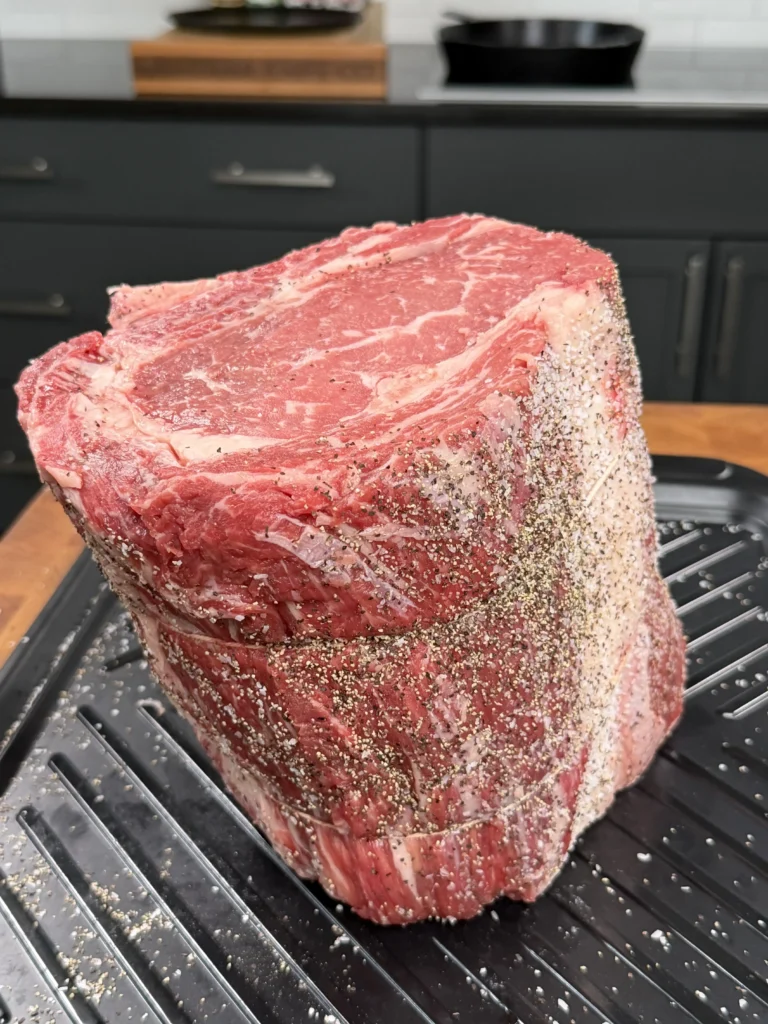
If your roast has a thick fat cap, score it lightly with a sharp knife. Make diagonal cuts about an inch apart, cutting through the fat but not into the meat. Create a crosshatch pattern. This helps the butter grip and allows fat to render during smoking.
Step 2: Make the Garlic Herb Butter
Place 1 cup of softened butter in a medium bowl. It should be room temperature and easy to mix. Add 8 to 10 cloves of finely minced garlic. The more garlic, the better. Fresh garlic is critical here since it releases oils that dried garlic can’t match.
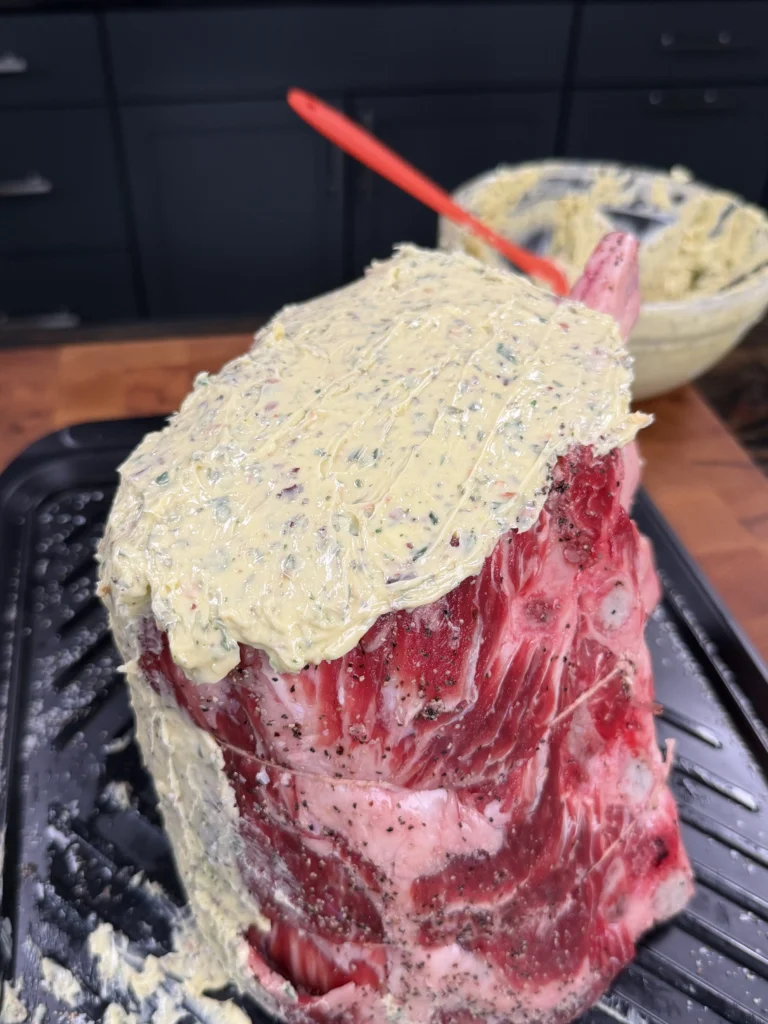
Add 2 tablespoons each of chopped fresh rosemary and fresh thyme. Add 1 tablespoon of chopped fresh parsley. These herbs provide the foundation of your crust. Rosemary brings pine and lemon notes. Thyme adds earthy complexity. Parsley contributes brightness.
Mix in 2 tablespoons of Dijon mustard. The mustard adds tang and helps the butter adhere to the meat. It also contains turmeric which contributes color. Add the zest of 1 lemon if using. Lemon zest cuts through the richness of beef and butter. Season with 1 teaspoon each of kosher salt and black pepper.
Use your hands or a spatula to mix everything together until uniform. You want the garlic and herbs evenly distributed throughout the butter. The mixture should be thick and paste-like. If it’s too soft, refrigerate it for 10 minutes to firm up slightly.
Coat the entire prime rib roast in the garlic herb butter. Use your hands to press it into every surface. Make sure to get it into the scored fat cap, between the ribs, and on the ends. Create a thick, even layer all over. The butter will look excessive but it melts during cooking. What remains creates your crust.

Step 3: Set Up the Smoker and Drip Pan
Preheat your smoker to 225°F. Use hickory, oak, pecan, or cherry wood for smoked prime rib. Hickory provides strong, bacon-like smoke. Oak is milder and more versatile. Pecan adds nutty sweetness. Cherry contributes subtle fruit notes and beautiful color. Any of these work perfectly with beef.
Place a large aluminum drip pan on the grate below where the prime rib will sit. The pan needs to be big enough to catch all the drippings. Use a disposable aluminum roasting pan or heavy-duty foil shaped into a pan.
Build your au jus base in the drip pan. Pour in 2 cups of low-sodium beef broth. Add 1 large onion cut into quarters. Add 2 to 3 chopped carrots and 2 chopped celery stalks. Throw in 6 smashed garlic cloves. Add 2 sprigs of fresh rosemary, 4 sprigs of fresh thyme, and 1 to 2 bay leaves.
If using optional ingredients, add 1 teaspoon of Worcestershire sauce for deeper umami. Add half a cup of red wine for steakhouse-style richness. The wine adds acidity and color to the au jus. These are optional but recommended.
The aromatics in this pan will steam and infuse the beef from below while catching drippings from above. Everything in the pan will combine to create your au jus later.
Step 4: Smoke the Prime Rib

Place the butter-coated prime rib roast on the grill grate directly above the drip pan. Position it so the drippings will fall into the pan. Insert a probe thermometer into the thickest part of the roast. Make sure it’s not touching bone since bone conducts heat differently than meat.
Close the smoker lid. Smoke at 225°F until the internal temperature reaches your target. For rare, pull at 118-120°F. For medium-rare, pull at 125°F. For medium, pull at 132°F. The roast will continue cooking during the reverse sear and rest.
Expect a cook time of 3 to 5 hours depending on the size of your roast. A 10-pound roast typically takes about 4 hours. Larger roasts take longer. Monitor the internal temperature rather than relying on time alone. Every roast is slightly different.
Don’t open the smoker unnecessarily. Each time you lift the lid, heat escapes and cooking time extends. Trust your thermometer. The smoke will penetrate the beef and the butter will brown gradually. The fat will render and drip down into the pan below.
When the roast reaches your target temperature, remove it from the smoker. Place it on a cutting board or sheet pan. Tent it loosely with aluminum foil. Let it rest while you prepare for the reverse sear.
Step 5: Reverse Sear the Crust
Increase your smoker or grill temperature to 450-500°F. Open all the vents if using charcoal. Turn up the gas if using a gas grill. Add more fuel if needed. Wait 10 to 15 minutes for the temperature to climb.
Once the heat is intense, place the prime rib back on the grates. Position it away from direct flame if possible. You want high heat but not charring. Close the lid. Sear for 8 to 12 minutes total.
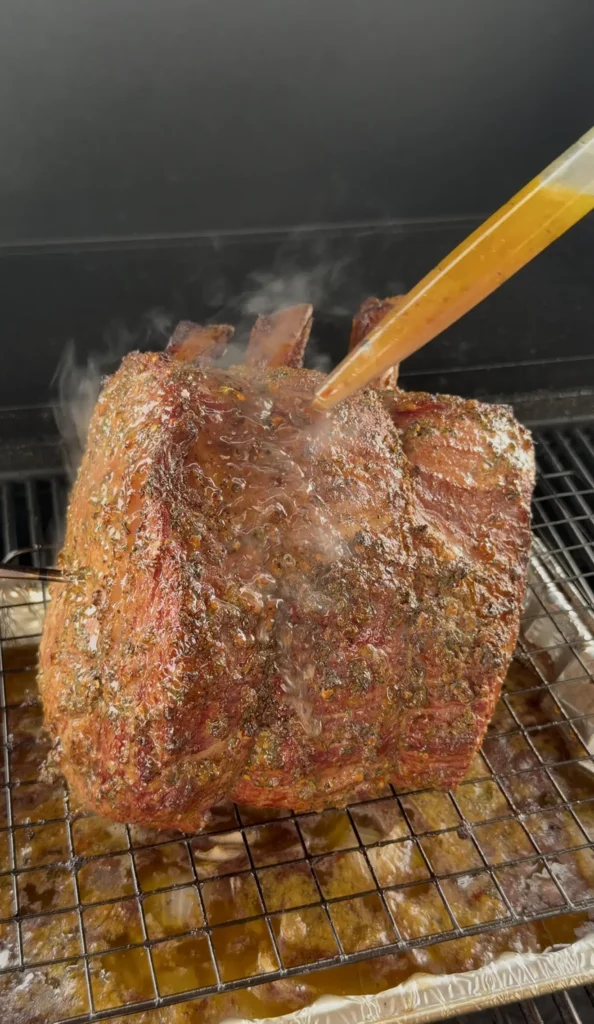
Watch the exterior closely. You want the garlic herb butter crust to darken and crisp. The fat cap should render further and turn golden brown. The herbs will toast and become fragrant. If you see heavy smoke or smell burning, reduce the heat slightly or move the roast.
The internal temperature will rise 5 to 10 degrees during this sear. That’s why you pulled it early. If you pulled at 125°F, it will climb to 130-135°F during searing and resting. This brings it to perfect medium-rare.
Remove the roast once the crust looks mahogany and crispy. Transfer it to a cutting board. Tent loosely with foil. Rest for 20 to 30 minutes before slicing. This resting period is non-negotiable. The juices need time to redistribute throughout the meat.
Step 6: Make the Au Jus
While the prime rib rests, make your au jus from the drip pan. Carefully remove the drip pan from the smoker. It will be full of hot liquid and rendered fat. Pour everything through a fine-mesh strainer into a medium saucepan. Press on the vegetables to extract all the liquid.
Let the liquid settle for a few minutes. Fat will rise to the top. Skim off excess fat with a spoon or ladle. You want some fat for richness but not so much that the au jus is greasy. Leave about a tablespoon of fat.
Place the saucepan over medium heat. Bring the au jus to a simmer. Reduce it for 10 to 15 minutes to concentrate the flavors. Taste and adjust the seasoning. Add salt if needed. Add black pepper for bite. Add a splash of red wine for acidity.
If the au jus tastes too strong, dilute it with more beef broth. If it’s too thin, reduce it further. You want it to be thinner than gravy but more substantial than plain broth. It should coat a spoon lightly. The color should be deep brown with reddish tones.
Keep the au jus warm until serving. Pour it into a gravy boat or small pitcher so guests can add it to their prime rib slices.
Step 7: Slice and Serve
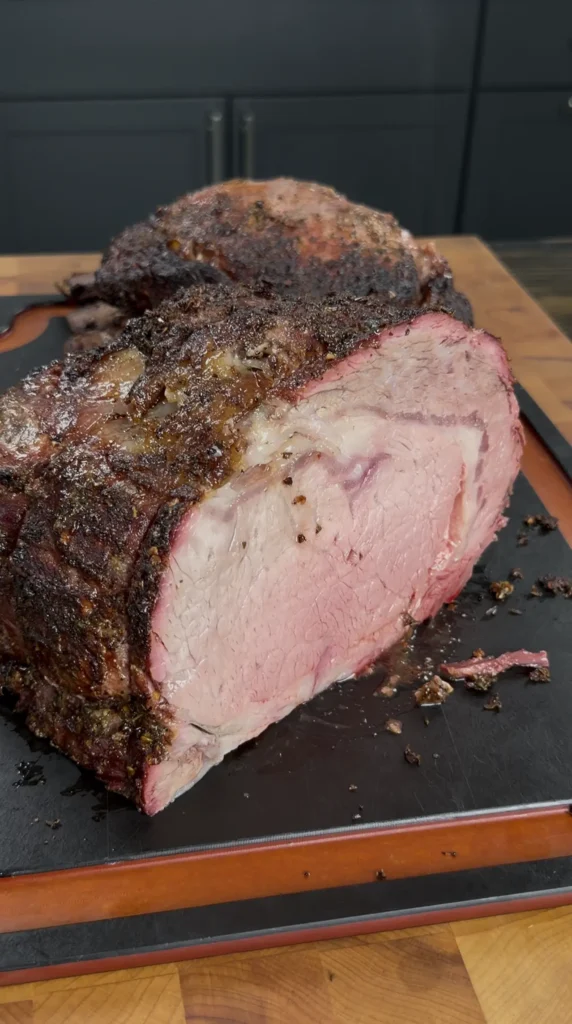
Place the rested smoked prime rib on a large cutting board. Remove the foil tent. Use a long, sharp carving knife. Cut along the bones to separate the meat from the rib rack. This gives you a boneless roast that’s easier to slice. Save the bones to serve separately or use for beef stock.
Slice the prime rib against the grain into portions about half an inch thick. Cut perpendicular to the direction of the muscle fibers. This shortens the fibers and makes each bite more tender. If you slice with the grain, the meat will be chewy.
Arrange the slices on a serving platter. Fan them out so each piece is visible. Spoon some of the warm au jus over the top. Let it pool around the slices. The juice will soak into the meat and glisten on the surface.
Serve immediately while hot. Provide the remaining au jus on the side for people to add more if they want. Offer horseradish sauce, creamy horseradish, or Dijon mustard as optional condiments. The smoky, herby prime rib doesn’t need much enhancement.
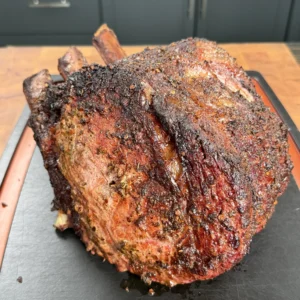
Smoked Prime Rib with Herb Crusted Garlic Butter
Ingredients
For the Prime Rib:
- 1 whole bone-in prime rib roast 5-7 bones, 10-14 lbs
- 2-3 tablespoons coarse kosher salt
- 1 tablespoon cracked black pepper
- 1 tablespoon smoked paprika
- 1 tablespoon garlic powder
- 1 tablespoon onion powder
- 1 teaspoon dried thyme
- 1 teaspoon dried rosemary
Garlic Herb Butter:
- 1 cup 2 sticks softened butter
- 8-10 cloves garlic finely minced
- 2 tablespoons fresh rosemary chopped
- 2 tablespoons fresh thyme chopped
- 1 tablespoon fresh parsley chopped
- 2 tablespoons Dijon mustard
- Zest of 1 lemon optional
- 1 teaspoon kosher salt
- 1 teaspoon black pepper
For the Au Jus Drip Pan:
- 2 cups beef broth low sodium preferred
- 1 large onion quartered
- 2-3 carrots chopped
- 2 celery stalks chopped
- 6 cloves garlic smashed
- 2 sprigs fresh rosemary
- 4 sprigs fresh thyme
- 1-2 bay leaves
- 1 teaspoon Worcestershire sauce optional
- ½ cup red wine optional
Instructions
- Remove prime rib from refrigerator 1-2 hours before cooking. Pat completely dry with paper towels. Mix dry rub: salt, pepper, paprika, garlic powder, onion powder, dried thyme, and dried rosemary. Coat entire roast liberally. Score the fat cap in a crosshatch pattern if thick.
- Make garlic herb butter by mixing softened butter with minced garlic, fresh herbs, Dijon mustard, lemon zest, salt, and pepper. Use your hands to coat the entire roast in a thick layer of this butter paste. Press it into every surface including scored fat cap.
- Preheat smoker to 225°F using hickory, oak, pecan, or cherry wood. Place large aluminum drip pan on grate below where roast will sit. Fill pan with beef broth, quartered onion, carrots, celery, smashed garlic, fresh herbs, bay leaves, and optional Worcestershire and red wine.
- Place butter-coated roast on grate above drip pan. Insert probe thermometer into thickest part away from bone. Smoke at 225°F until internal temp reaches 118-120°F for rare, 125°F for medium-rare, or 132°F for medium. Expect 3-5 hours.
- Remove roast and tent with foil. Increase smoker temperature to 450-500°F. Once hot, return roast and sear for 8-12 minutes until crust is crispy and mahogany colored. Remove and rest for 20-30 minutes tented with foil.
- Pour drip pan contents through fine strainer into saucepan. Skim excess fat. Simmer 10-15 minutes to reduce. Taste and adjust with salt, pepper, or splash of red wine. Keep warm until serving.
- Slice prime rib against the grain into half-inch portions. Arrange on platter and spoon warm au jus over top. Serve immediately with remaining au jus on the side.
Frequently Asked Questions
What Internal Temperature Should I Pull Prime Rib Off the Smoker?
Pull smoked prime rib at 118-120°F for rare, 125°F for medium-rare, or 132°F for medium. These temperatures are measured at the thickest part of the roast, away from the bone. The meat continues cooking after you remove it from the smoker. This is called carryover cooking.
During the reverse sear at 450-500°F, the internal temperature rises another 3 to 5 degrees. During the 20 to 30 minute rest period, it climbs another 2 to 5 degrees. If you pull the roast at 125°F, it will finish around 130-135°F. This lands perfectly in medium-rare range.
If you cook the prime rib to your final target temperature on the smoker, it will overshoot during searing and resting. You’ll end up with medium or medium-well instead of medium-rare. Most people prefer prime rib on the rarer side since it’s such a premium cut. The fat marbling stays soft and buttery at lower temperatures. It firms up and loses its luxurious texture as it cooks past medium.
Use a reliable probe thermometer inserted into the center of the roast. Don’t trust oven thermometers or guessing based on time alone. Prime rib is expensive. Accurate temperature monitoring is the only way to guarantee perfect results.
Can I Smoke Prime Rib Without a Reverse Sear?
You can skip the reverse sear, but your herb crusted prime rib won’t have the same crispy exterior. The low smoking temperature of 225°F cooks the meat gently but doesn’t create a crusty bark. The garlic herb butter melts and browns lightly. The herbs soften but don’t toast. Without high heat at the end, the exterior stays relatively soft.
The reverse sear crisps the butter crust and caramelizes the fat cap. It toasts the herbs and creates textural contrast between the outside and inside. This step adds 10 to 15 minutes to your cook time but makes a significant difference in the final product. The Maillard reaction at 450-500°F creates hundreds of flavor compounds that don’t develop at 225°F.
If you can’t reverse sear because of equipment limitations, increase your smoking temperature to 275°F for the last 30 minutes. This provides some crust formation though not as dramatic as a proper sear. You can also finish the prime rib under a broiler. Move it to the oven and broil on high for 3 to 5 minutes. Watch it closely to prevent burning.
The best results come from smoking low and slow, then searing hot and fast. This gives you both tender interior and crusty exterior.
How Much Prime Rib Should I Plan Per Person?
Plan for 1 pound of bone-in prime rib per person for generous servings. A 10-pound roast serves 10 people. A 14-pound roast serves 12 to 14 people. This accounts for bone weight, fat trim, and the fact that prime rib is rich. People eat less of it than they would of leaner cuts.
If you’re serving multiple sides, salads, and appetizers, you can reduce this to three-quarters of a pound per person. For a prime rib-focused meal with minimal sides, stick with a full pound. It’s better to have leftovers than run out. Leftover prime rib makes excellent sandwiches, hash, or beef stroganoff.
Bone-in roasts have more waste than boneless. The bones add flavor during cooking but aren’t edible. They account for about 15 to 20 percent of the total weight. Factor this in when buying. If you want to serve 10 people half-pound portions of actual meat, buy a 7 to 8-pound bone-in roast.
Butchers typically sell prime rib by the number of ribs. Each rib section serves about 2 people. A 3-rib roast serves 6. A 5-rib roast serves 10. A 7-rib roast serves 14. Ask your butcher for guidance based on your guest count.
Can I Make This Recipe in the Oven Instead of a Smoker?
You can adapt this smoked prime rib recipe for the oven, but you’ll lose the smoke flavor. Preheat your oven to 225°F. Season and butter the roast as directed. Place it on a roasting rack over a roasting pan filled with the aromatic drip pan ingredients. Roast until the internal temperature reaches your target.
For smoke flavor without a smoker, add liquid smoke to the garlic herb butter. Use 1 to 2 teaspoons mixed into the butter paste. This provides subtle smokiness though not the same as real wood smoke. You can also use smoked salt in your dry rub instead of regular kosher salt.
After the roast reaches temperature in the oven, increase the heat to 500°F for the reverse sear. Or use the broiler setting for 8 to 10 minutes. Watch it closely to prevent burning. The high heat will crisp the herb crust similarly to grilling.
The au jus develops the same way in the oven as on the smoker. The drip pan catches all the drippings. You strain and reduce them as directed. The main difference is smoke infusion. Oven-roasted prime rib tastes excellent but less complex than smoked.
Should I Let Prime Rib Come to Room Temperature Before Smoking?
Yes, remove prime rib from the refrigerator 1 to 2 hours before smoking. Let it sit at room temperature on the counter. Cold meat from the fridge has an internal temperature around 38-40°F. When you put cold meat in the smoker, the exterior heats up quickly while the center stays cold. This creates uneven cooking.
Room temperature meat starts around 65-70°F. The temperature gradient from outside to inside is less extreme. The roast cooks more evenly. You get better edge-to-edge doneness instead of a thick gray band of overcooked meat around a rare center.
Food safety concerns about leaving meat out are minimal for whole roasts. Bacteria multiply on surfaces, not in the interior. The exterior gets cooked thoroughly during smoking and searing. A whole roast sitting out for 1 to 2 hours is safe. Ground meat is different since bacteria get mixed throughout during grinding.
If your kitchen is very warm, above 80°F, reduce the time to 1 hour. In cooler kitchens, 2 hours is fine. Pat the roast dry before applying seasoning and butter. Room temperature meat also accepts the garlic herb butter better since the butter doesn’t firm up on contact with cold beef.
If you’re looking for more recipes , click the link! Check out all of our grilling recipes here for more steak, seafood, and BBQ favorites that are perfect for your next cookout.
COMMON ITEMS USED IN THESE RECIPES
Hasty Bake Charcoal Grill and Smoker
Knitted Gloves
Food Processor
Cast Iron Skillet
Meater +
Upgrade Your Meat Game with Grill Nation x Linz Heritage Angus
If you really want to take your grilling and cooking to the next level, you need to check out our collaboration with Linz Heritage Angus. We’ve partnered with them to bring you some of the best beef you can get your hands on.
Linz Heritage Angus isn’t your typical grocery store meat. These guys are the real deal – they raise their cattle the right way, and you can taste the difference in every bite. We’re talking about beef that’s been dry-aged to perfection, with marbling that makes your mouth water just looking at it.
Check out these premium cuts that’ll change how you think about beef:
Premium Ribeye Steaks – Perfect for special occasions
Dry-Aged Beef Selection – Take your grilling to the next level
Ground Beef & Burger Blends – The foundation of great BBQ
Use code GN15 at checkout for 15% off your first order. Trust me, once you try Linz Heritage Angus, you’ll never want to go back to regular store-bought beef.