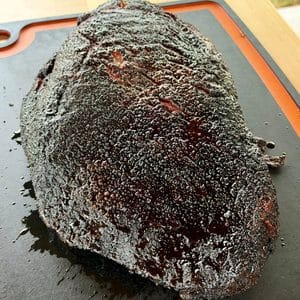
Smoked Brisket Recipe
This Smoked Brisket Recipe features a whole packer brisket seasoned with kosher salt and coarse black pepper, then slowly smoked over charcoal with hickory wood chunks. The brisket develops a deep bark before being wrapped with homemade beef tallow and finished until probe tender. A long, controlled rest produces tender, juicy slices with rich beef flavor and a smoky crust.
Equipment
- Charcoal smoker
- Hickory wood chunks
- Instant-Read Thermometer
- Butcher Paper
Ingredients
- 14 lb whole packer brisket
- 1/4 cup Yellow mustard
- 1/4 cup Kosher salt
- 1/3 cup Coarse Black Pepper
- 3 tbsp Beef tallow
Instructions
- Trim and Shape the Brisket: Start with a cold whole packer brisket. Remove the hard deckle fat near the point and flat, exposed silver skin, loose pieces of meat, and excessively thin edges that could dry out during smoking. Round the corners and trim the fat cap to 1/4-inch, creating a smooth, uniform shape. Save the useable fat trimmings for rendering into beef tallow.
- Apply the Binder and Season: Spread a thin layer of yellow mustard over the entire brisket. Combine 1/4 cup kosher salt and 1/3 cup coarse black pepper, then season all sides evenly, pressing lightly to help the mixture adhere. Place the brisket on a wire rack over a baking sheet and refrigerate uncovered for 1 hour, allowing the salt to begin dissolving into the surface.
- Prepare the Smoker and Render the Tallow: Preheat your charcoal smoker to 225°F and add hickory wood chunks. Place the brisket fat side down, positioning the thicker point toward the strongest heat source. Add the reserved fat trimmings to an aluminum pan and place it inside the smoker to slowly render. Maintain a consistent temperature and clean smoke, checking the rendered fat periodically. Continue smoking for 8—10 hours before your main bark inspection, monitoring the smoker and brisket temperatures throughout.
- Check the Bark and Wrap: Once the brisket develops a deep, dark bark that feels dry and firmly set, typically around 175—185°F, prepare two overlapping sheets of food-grade, unwaxed butcher paper. Drizzle a little strained beef tallow onto the paper, place the brisket fat side down, and spoon a few tablespoons of tallow over the top. Wrap tightly, return the brisket to the smoker with the point facing the main heat source, and increase the temperature to 250°F.
- Finish Until Probe Tender: Continue smoking the wrapped brisket at 250°F. As the internal temperature approaches 200°F, begin checking the thickest part of the flat with a temperature probe, avoiding large pockets of fat. The brisket is finished when the probe slides through several areas with very little resistance, similar to softened butter. This typically happens around 202—205°F, but tenderness determines when it's ready.
- Rest, Slice, and Serve: Remove the brisket from the smoker and allow the wrapped meat to cool slightly under temperature monitoring. Transfer it to a temperature-controlled oven or warmer at 140—150°F for a 3—4 hour hold, keeping the brisket at or above 140°F. Unwrap over a tray to collect the drippings. Identify where the point and flat overlap, then slice the flat against the grain into 1/4-inch, pencil-thick slices. Rotate or separate the point to follow its different grain direction and cut slightly thicker, around 3/8-inch. Spoon the warm drippings over the sliced brisket and serve.
Notes
- Brisket Doneness: Internal temperature is a guideline, not the final indicator. Start checking the flat around 200°F and remove the brisket when the probe slides through several areas with very little resistance, typically around 202—205°F.
- Resting and Holding: For a 3—4 hour hold, use a temperature-controlled over or warmer and monitor the brisket to keep it at or above 140°F. Allow the brisket to cool slightly before holding to limit carryover cooking. A turned-off oven cannot reliably maintain a safe temperature for an extended hold.
- Wrapping: Food-grade, unwaxed butcher paper is recommended for maintaining bark texture. If using parchment paper, verify that it is rated for the cooking temperature and suitable for wrapping meat.
Nutrition
Calories: 630kcalCarbohydrates: 3gProtein: 83gFat: 30gSaturated Fat: 10gPolyunsaturated Fat: 1gMonounsaturated Fat: 14gTrans Fat: 0.001gCholesterol: 246mgSodium: 2126mgPotassium: 1381mgFiber: 1gSugar: 0.1gVitamin A: 30IUVitamin C: 0.02mgCalcium: 45mgIron: 8mg
Tried this recipe?Let us know how it was!
